1 - Introduction
Originally from Paris, France, I have lived in the United States since 1986. Making my home in Arizona, my favorite photographic locations include Navajoland, where I lived for 7 years, the Grand Canyon, where I sell my work and where on average I spend over 50 days a year, and the rugged canyonlands wilderness of Southern Utah and Northern Arizona.
I currently work with medium format and 35mm. The choice of which camera I use is based on my vision for each image. While I started photographing with film, and worked with 4x5 large format for a long time, I now use 35mm digital cameras and medium format digital cameras. The 35mm cameras are used for photographs that require speed flexibility, while medium format digital back cameras are used for the majority of my landscape work.
My goal is to create the most exciting photographs possible, bar none. My equipment, be it cameras, software, printers, etc. is chosen for its ability to make this possible. My vision of the landscape is of a place of beauty, a place where we can experience a direct contact with nature, a place where we can find respite from the pressures and stresses of the 21st century, a place where we can find inspiration and freedom of expression.
The quality of my work is the results of two factors: hard work and natural abilities. I have been an artist all my life and I was never pushed to make art either by my parents or anyone else. I had, undoubtedly, a personal attraction for creative endeavors and for all things artistic. However, only through hard work did this natural ability result in the work I am creating today.
My first photographs are not displayed on this site and that is because they are nowhere close to the quality I seek. Only hard work, dedication, and the decision to never ever quit are responsible for turning what may be called a natural talent into images that are a representation of my vision. The vision was always there. The ability to turn this vision into expressive images is something I achieved after years of work and study. I started photography in 1980 and I am starting to create some of the most satisfying images I have ever created.
If you have just started photography, and are not satisfied with your current results, don't despair. It took me 25 years to create the image quality you can see on this website (the actual prints look much better than the web images of course). If it takes you ten times less than that to create images that you really like, you will be "burning rubber" in the field of art and photography.
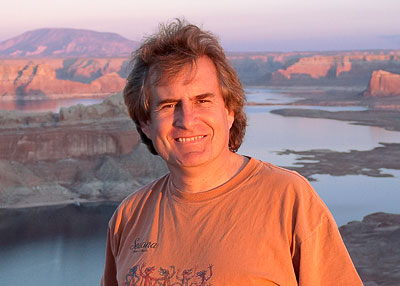
Alain Briot
See more photographs of Alain and Natalie by clicking here
2 - About this website, my endeavors and my reflections on photography
This website can be considered the "center" of my work on photography. This work, and concurrently this website, consists of three main parts: fine art photographs, workshops and publishing.
I make a very good living selling my fine art photographs, and should I want to I could leave my artistic endeavors at that. The problem is that I do not feel this is enough to make me "whole" for lack of a better word. Just creating photographs and selling my work is not enough to satisfy my interest in photography. I need to do more.
For one, I love to share my knowledge. Not every artist feels that way. For some, the creative act, and the knowledge that comes with it, is a purely personal experience. Personally, I believe that all art is performance and that, in this respect, the proof that one is a professional artist is being able to perform one's art in public. Working with students does offer this opportunity, and so does photographing places visited by numerous people, such as the main overlooks of Grand Canyon National Park, or photographing in Paris, for example.
More importantly, this performance aspect that photography, like any art, possesses, means sharing what you do with others instead of just sharing the resulting product of what you do. In regards to photography it means sharing the process I go through to create an image, instead of just sharing the image alone, the result of this process if you will. Teaching is only one step away from this, being the sharing of my knowledge in a format that is accessible to all, as well as doing so in progressive steps, so that photographers from all levels, from beginners to experienced artists, can learn, improve and benefit.
For two I love reflecting and writing about photography. In a way, this is what I am doing now. In fact, I find photography to be one of the richest fields for critical reflection. Why? First, because photography is one of the fastest growing art medium. Second, because numerous myths surround photography, in particular myths about how good photographs are created. I challenge these myths in my essays because I see them as hurdles preventing photographers from reaching the next step with their work.
3 - About our Teaching Experience
Natalie and I both hold University teaching degrees. We actually studied how to teach far before we ever thought of organizing and teaching photography workshops and seminars. Natalie was trained as a Secondary School art teacher while I was trained as a University Humanities teacher. Together, we have over 15 years of experience teaching at the Public School and at the University level.
One of the most important things we learned during our teaching studies is that to improve student education it is necessary to first improve teacher education. Both Natalie and I studied at Northern Arizona University in Flagstaff, and we were both fortunate to have excellent University professors as teachers. Natalie holds a Bachelor's Degree in teaching while I continued all the way to a PhD in Humanities with a focus on Photography as visual communication.
Teaching cannot be improvised. It has to follow a plan and consist of steps, exercises, lessons, detailed syllabus', the ability to develop good teacher-student relations and more. Above all, good teachers must be able to reflect on their teaching and be able to instigate a strong sense of self esteem in their students. They must also know their subject well and be daily practitioners of what they teach.
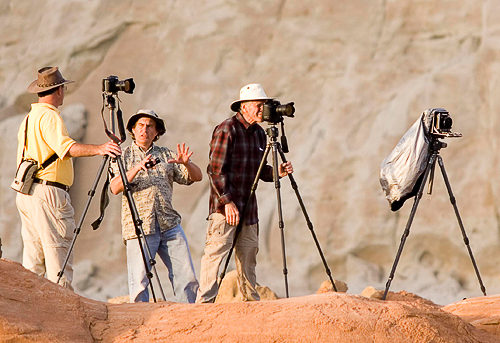
Alain teaching photography in the field
Photograph by Neil Gundel
4 - About my studies
I have been studying and practicing art since I was very young, first with my parents, then in grade school because art and music were a significant part of the curriculum when I was in grade school in France, with 4 hours of teaching on this subject alone minimum each week. And finally by specific art studies in a private school in Paris (The Atelier D'Enfer in Paris), followed by formal studies at the Academie des Beaux Arts also in Paris.
At the Beaux Arts I studied painting and drawing. I also studied light, composition, tonality control, balance and many other concepts that have traditionally been part of a formal visual arts education. My teachers were professional painters and artists, and I studied and practiced art all day long, 5 days a week. Today, I find myself referring to this education and to the concepts I learned at the Beaux Arts on a near-daily basis. In fact, I find that one of the things that differentiates my work and the work of other photographers is my Beaux Arts education, an education that has given a solid foundation to my work, a foundation that I build on today using the latest tools and technology.
After the Beaux Arts I studied photography at the American Center in Paris, because at that time some of the finest photography teachers, both from France, the United States and other countries, taught and exhibited their work there. One of my primary teachers was Scott MacLeay. I studied lighting, composition, field work, studio work and darkroom work for 4 years at the Franco-American Center.
Afterwards, I applied this knowledge by photographing extensively throughout the world and more recently in the United States with currently a focus on the Southwest. During that time, as well as before and after, I studied the work, life, philosophy and approach of many photographers whose work I admired, with the goal of becoming as good as they were. I also continued to study photography, in particular with Al Weber.
Today I continue my personal photography work by photographing extensively year-round with the goal of creating fine art images that express my personal vision. I also write extensively about the artistic aspects of photography. My writings are published on my web site and on numerous other web sites, on CD's and DVD's as well as in print. To this day I have published 3 books, hundreds of essays and articles and my work has been translated in over 15 different languages.
Overall, my personal art and photography studies took a very long time. I started studying photography in Paris in 1980 and I did not create images that were fully satisfying to me until around 1996 when I started doing photography full time. I realize that I had the luxury of time, and I also realize that most people cannot devote 15 to 20 years to learn what I know. To remedy this problem I designed a workshop and seminar program whose goal is to share the extent of my knowledge in a practical and time-saving manner. I also designed a line of CD and DVD tutorials whose goal is identical to that of my workshop program but without the need to travel. Finally, I also offer one on one mentoring and consulting opportunities for students who prefer a personalized and fully interactive approach. If you are interested in these opportunities visit the Workshops page on this site.
|
Adobe Photographers Directory Member |
|
NANPA Member |
|
DxO Image Master |
|
Contributing Editor, NaturePhotographers.net |
|
Senior Columnist,
Luminous Landscape.com |
 |
Contributing Editor,
OutbackPhoto.com |
 |
instructor
Phase One Digital Artist Series |
 |
Columnist, landscape photography magazine |
 |
Columnist, Light & Shadow magazine |
 |
Columnist, Light and Landscape magazine |
You can read a previous version of my biography at this link
And
see more photographs of Alain and Natalie here
Copyright © Alain Briot, 2016